Have You Heard This? text logo, rectangle
Writing Toolbox Aaron Hertzog Writing Toolbox Aaron Hertzog

Comedy Writing Toolbox: Make Lists!

Gather your ideas so you can turn them into things.

Gather your ideas so you can turn them into things.

When I taught a comedy writing class, the first homework assignment for students was to get a notebook and to start carrying it with them at all times. I love a good notebook. To be more specific, I love good notebooks. I’m typically using a few at the same time. I use small notebooks for quick thoughts, medium notebooks for long-form writing, and large notebooks for freewriting brain dumps. I have specific notebooks dedicated to just a single topic. I use legal pads for script writing. I use a notes app on my phone to capture thoughts on the go - but always transfer the stuff in the digital note to paper later. Usually I’ll transfer it to another digital document later, where it can live until it morphs from “idea” into “thing”. I’ll admit that my system is probably overkill. One notebook plus one digital backup is really all you need. But if it ain’t broke…1

The next assignment after getting a notebook was to start using it. I find that the simplest and easiest way to get into the habit of using a notebook is to start making lists. It’s also a great way to start gathering ideas to eventually turn into things.

But what kind of lists, exactly?

The first list I recommend keeping is simple and straightforward: Things That I Find Funny. I’m looking for comedy ideas, so it’s a no-brainer to keep a list of things that make me laugh. I fill this list with silly thoughts, weird things I’ve done, and things that I find peculiar or strange (the “what’s the deal with…” kinda stuff). When looking for ideas to turn into a joke or an article or whatever, this is probably the first list I’ll check - because it’s already made me laugh in some way - I can figure out where to go from there.

Next in my list of lists are Things That I’m Interested In and/or Things That I’m Curious About and/or Things That I’m Obsessed With/Can’t Stop Thinking About (these can be three separate lists or one list, depending on how detail-oriented you want to be with list labels.) If comedy comes from the finer, specific details deep in the weeds of a topic, I’m already on the right path if it’s something I’m obsessed with and have been thinking about nonstop for a while. If it’s something that I’m genuinely interested or curious about, I won’t mind doing the research to find out more about it. Even if it doesn’t turn into a joke, I know more about something I was interested in, that’s a win!

Comedy often comes from strong emotions,2 so I like to keep lists of things that:

  1. I Love

  2. I Hate

  3. I Am Afraid Of

  4. Make Me Feel Confused or Stupid

  5. Make Me Anxious

  6. Embarrass Me3

The Feelings Wheel is a great place to start if you need to kickstart a writing session and you don’t know where to begin. Pick any old slice of the pie and start writing down things that you associate with that feeling. It could be things from within, things you witness in others, memories from your past, or completely made-up stories inspired by that emotion. I bet you’ll think of something funny before too long.

Two other lists I keep are Things I Agree With and Things I Disagree With. These can come from news stories, opinions I hear from other people4, general concepts/ things that we accept about our everyday lives. These are a great way to get relatable material on topical or universal subjects, if that’s the kind of material you’re looking for.

This next suggestion is a doozy - it takes a bit of self-reflection and introspection, but can lead to some great material if you’re brutally honest with yourself: Things I Avoid. The items on this list will most likely tie back to/fit in one of the lists of strong emotions (afraid of, embarrass me, etc.), but might not be as immediately evident. It might take a while to even realize there’s something I’m avoiding, but once I figure it out, I’m on a path to some real, honest, vulnerable stuff.

All of those lists are great for general idea-gathering and jump-off points. I also keep lists that are more specifically targeted to script writing. These lists help me remember little things that might make for good character or scene details someday. Things like:

  1. Funny/Interesting Imagery

  2. Settings

  3. Character Types5

  4. Quotes/One-Liners/Conversations

  5. Songs to use6

With all these lists, you’ll never have to start writing from a completely blank page, there’s always something to start from. Where to take it from there is something to cover at a later time.


1

Honestly, it might be broke. Maybe just stick to one notebook at a time.

2

Or, at least, pretending to have strong emotions about something.

3

Or would embarrass me if they actually happened and weren’t just daydreams.

4

Or read online - let’s be honest, mostly ones I read online.

5

This could be a person whose actions inspire a character, or an occupation that makes me think “what kind of person would want to do that job” or bits and pieces I observe from people that make me want to fill in the blank or think of a story.

6

Sometimes I just think a song is cool and other times when listening to a song I can picture certain action happening that I feel like would fit with the song.

Read More
Writing Toolbox Aaron Hertzog Writing Toolbox Aaron Hertzog

Comedy Writing Toolbox: Little Tricks

Taking an idea to a finished product by way of little writing tricks.

Taking an idea to a finished product by way of little writing tricks.

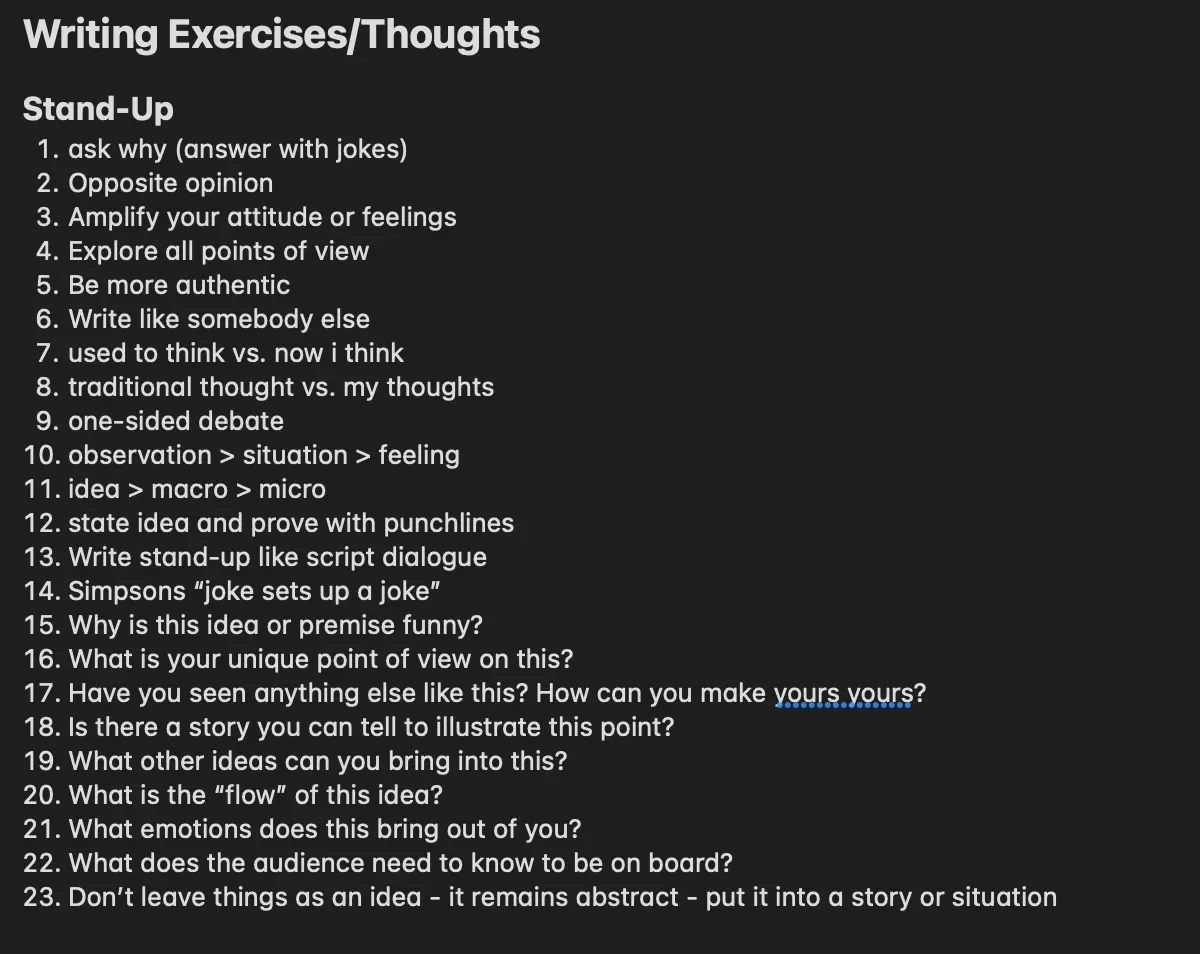
Comedian slash writer slash prolific Substacker Matt Ruby posted a great article on his Funny How: Letters to a Young Comedian (recommend!) this week that he called “Ways to make it funny.” In short, he found a list of writing tips he made from studying what tools comedians used in their jokes to get from premise to punchline. You can read the full list here:

Funny How: Letters to a Young Comedian

Ways to make it funny

As a joke dork, this is the stuff I eat right up. It’s also the stuff I do all the time. When I hear a joke I love or that stands out to me, I like to stop and think about it. I’ll re-listen to the joke and break it down. I’ll make up stories in my head about where the comedian was or what they were doing when the inspiration for the joke hit them. I’ll picture them out in public, or having a conversation with a friend, and falling into the situation that inspired them. Sometimes a joke feels like it came up naturally through a lightning-bolt of inspiration, while others feel like an idea that came about through getting deep into the weeds of free-writing or journaling or whatever sort of writing method the comedian might use. Of course, I could be way off course to how the joke was actually created, but by making up a story, I help myself create a path to creating my jokes in a similar way.

Inspired by Matt’s post, I wanted to share my list of stand-up writing “little tools” that I use to help me work through an idea.

Some of these are vague or use terminology that only makes sense to me. Others are pretty clear-cut. But I think I’m going to explain them more in future posts here.

Read More
Writing Toolbox Aaron Hertzog Writing Toolbox Aaron Hertzog

Comedy Writing Toolbox: Takeaways

How to be inspired by the art that you love without stealing from the artists that you love.

How to be inspired by the art that you love without stealing from the artists that you love.

I’m always trying to understand myself. I think that’s a good practice to have as an “artist” and as a “person.”1 It’s a bit navel-gazy, for sure, but I think it works in a “put on your own oxygen mask before you help the person next to you with theirs” type of way. If I can understand myself, then what I create can be more authentic and true, and more people can relate to it, because I am relatable, because I am a person just like them.2

Finding my own unique voice as a creator is part of this neverending quest to understand myself. Part of the reason the quest is neverending is because it is difficult, but another part of it is because I’m (hopefully) always evolving and growing as a person, so my “specific and unique” authentic voice is, in theory, also evolving right along with that. If I’m slightly different today than I was yesterday, than so should my perception of the world, and my reaction to it, and what I create. This sounds like self-torture, but I assure you it is not.3 I’m not always thinking this deeply about it. Most of it happens naturally.

I like to think of it this way. If I try to do a joke about myself that I wrote ten years ago, I really hope it kind of rings false when I’m saying it. It should feel a bit inauthentic. It should feel like I’m doing somebody else’s material. Because I’m not the same person that I was a decade ago.

Part of finding your own voice as a creator happens through identifying things that you like as a fan and consumer of art. I’ve heard it said that “all artists” start out doing impressions of their favorite artists, taking a little piece here or there until they figure out what works for them and fall into developing their own style. I don’t know if that’s true for everybody, but I know it was true for me. I remember once, after doing a five-minute guest set at a comedy club, an out-of-town comedian who saw my set read me dead to rights on my favorite comics4. I wasn’t “copying” them but my influences were certainly clear to someone who knew comedy. I knew in that moment I had more work to do in developing my own unique style. Hopefully in the years since I’ve made progress on that.

Anyways one of the ways I use my “refined taste” as a consumer of art as a tool in shaping my own voice as a comedian and writer is something I call “takeaways.” Basically, after watching something, I’ll think about what I liked about it5. I keep a document of the major things that stand out so I can remember them when I’m creating. In order to not be “stealing” from the specific voice of the creator I try to keep these things structural. I try to take away something about the formatting of the story or the way it presents ideas — instead of things about the “voice” or specific tone of the joke, or movie, or comedy special. Another way I look at this is as “reverse engineering” the idea by looking at the finished product. I use my own takeaways from the art to think about what I believe the process of creation was like to think about how I’m going to create when I’m creating.

These things can be big, major structural notes and ideas, or small things about the way they present their story or idea. Some of them may seem obvious. Some of them my be present in many other films (or a staple or “rule” of writing). I’m not worried about any of that. If it stands out to me, and I like the ways it’s done specifically as an example in a certain film, it goes in the doc.

Here are some examples of recent Takeaways to show you what I mean. Maybe there will be some slight spoilers for some of these movies but I’ll try to keep it pretty vague.

Queer
The item the main character is on a search for in the plot of the film (a plant that is rumored to give people the ability to communicate telepathically) is a metaphor for what his character needs in the story (better communication with his partner/other people in general.)

Tangerine
Something I wrote about in a previous newsletter — I found it refreshing that Sean Baker reused some of the ideas, themes, settings, and even gags (puking in a car) in his later films. It makes me less afraid to revisit similar subjects in new jokes or scripts that I’ve written about previously.

Oh, Canada
Small examples throughout the film (individual scenes or even single lines of dialogue) that represent or state various major themes of the film. This one is specifically an example of something I noticed in this film that is probably, like, a “rule” of screenwriting or something. But I’ve never taken a class, I just noticed how this movie did it so I wrote it down as a nice little trick.

Babygirl
I like how this film avoided and subverted some specific cliches and stereotypes that could have made it a much less interesting movie. My takeaway here was to think about the type of story (or joke) that you’re telling and be aware of what the “cliches” of that story/joke would be so that you can avoid them or subvert them.

The Silent Partner
I felt like the tone of the film did not match the events going on in the plot. The tone was quite light while the plot was very dark. I didn’t love how that juxtaposition felt when I was watching the film. So my takeaway here is to make sure they do match when I’m writing — or that it “makes sense” in the way that the tone and story/plot juxtapose each other.

Your Friend, Nate Bargatze
I’ve been doing stand-up a lot longer than I’ve been writing scripts. I have a better feel for my voice as a stand-up and how I write jokes than I do of script-writing. Most of my recent takeaways have been little notes for me when I’m working on a new script. I figured I’d add a stand-up specific takeaway here so there’s at least one example. In Bargatze’s new special, he does a good chunk of material about disagreements with his wife. He makes sure that he’s the butt of his own jokes for a while before he starts in on jokes at her expense. This makes sure he doesn’t come off as mean to her, but also makes sure he’s not always the loser in every situation.

OK, see what I mean now by “Takeaways.” I’m not going to use all of these in everything I write (that would be exhausting to do, and most likely result in an “overwritten” script that would be exhausting to read) but they’re there if I need them, or if I feel like something is missing or needed when I’m outlining or rewriting. Keeping things structural also avoids any “I see what you did there — you took that idea from this” moments from happening. Inspiration happens, it’s inevitable, but by being aware of those inspirations and what inspires me I can use those inspirations in a productive, original way that fits my own voice — however it may evolve.

1

Why are these words in quotes? Well, calling myself an artist feels pretentious, so I use the quotes as a thin layer of protection. And then using them on the word person is just a weird funny joke I guess. What is a person? Am I one?

2

There, the “person” thing came full circle, within a few sentences.. I guess I am also an “artist.”

3

Not all the time, at least.

4

Paul F. Tompkins and Patton Oswalt

5

Sometimes also what I didn’t like about it.

Read More
Writing Toolbox Aaron Hertzog Writing Toolbox Aaron Hertzog

Comedy Writing Toolbox: "Three Steps" to Success

Writing comedy is a "very simple" three-step process. If I can do it, so can you.

Writing comedy is a "very simple" three-step process. If I can do it, so can you.

I think a lot about comedy writing. That might be fairly obvious and only needs to be stated for people who are new here or those who haven’t been paying attention. It’s one of the main things I discuss here in my writing. My podcast started (and continues) as a way for me to talk to other comedians about their writing process, and join in on the fun.

“Fun” is the key word. I try to latch on to the fun in the creative process instead of banging my head against a table in frustration. Sometimes, that’s easier said than done. Making the process a collaborative effort has always helped me focus on the fun.

So I might as well write about it too.

Part of my writing process is always analyzing my writing process. It can be a vicious cycle where I spend more time thinking about writing than actually writing. I think a lot of “writers” do this. If you poke around on Substack, many publications are about writing instead of just writing.

But I do see the benefit of documenting my writing process and tools here. It’s a way to start a conversation with readers, attract new readers (and listeners; this is also a podcast), and remind myself of the tools I use when I need them.

So, I’m going to take all my little notes, reminders, tips, and tricks and turn them into posts here. This is for my own future reference and for anybody out there who might want to know about my comedy writing process or pick up some tools that could work for them as well.

So, here’s the good news: as I see it, writing comedy comes down to a three-step process.

The bad news? Are you sure you want the bad news?

The bad news is that each of those three steps has about a zillion potential steps, pathways, questions to figure out, and ways to doubt yourself within them. Infinite timelines, baby! And only one leads to creating a “perfect” joke. OK, more good news, that’s a lie! Many ways lead to great jokes, and no joke is perfect.

I guess there’s even more good news: any one of those zillion potential steps, pathways, questions, and ways to doubt yourself can be discussed in a piece here. So I’ll have a lot of things to write about. But, for now, let me break down what I see as the “three steps” to writing comedy.

Step One: Generate

Step Two: Understand

Step Three: Create

There. We’re done here.

Oh, you want me to explain more? OK. Here.

Step One: Generate

“Where do your ideas come from?” This is a classic question asked to many comedians and other creators. Step one in my “simple, three-step process” is recognizing ideas, topics, premises, and subjects you’d like to discuss in your comedy. My comedy? Should I write like I’m talking to you or myself? I’m really talking to both of us. Our comedy?

Anyways, generating ideas is the first step on our way to creating comedy.

Sometimes, an idea that is seemingly fully formed will come to me. The joke will be complete and ready to do on stage. I hope this happens to you, too. Because it is great. I used to think this was just some moment of divine inspiration but I realized after years of doing comedy that most likely, it’s something that I have already spent a lot of time thinking about, either in the front or back of my brain. It could have been inspired by a conversation I had with someone days ago and already forgot about, an article I read, or something somewhere that kickstarted that thought that eventually turned into a fully formed idea.

My goal is to recreate that process on purpose to manufacture those moments of “divine inspiration.”

When I taught a comedy writing class (yes, I used to teach a comedy writing class) the first thing I told students in the class was to get a notebook. I still believe in the “pen and paper” notebook although I also use a notepad app on my phone. For many reasons, I go back and forth from one note-capturing tool to another. The phone is often quicker, but I find that writing by hand allows my brain to process ideas at a speed that works better for creating. You’ll want to have a “notebook” to keep your ideas, capture your thoughts, and organize your bullshit for later.

The next best thing is something that strikes you as “funny.” You see something or say something or think about something that’s basically “oh, that’s funny” or “oh, that’s weird.” Great. Write that shit down. Work on it later. That’s one of the next two steps.

Other times you’ll have to work on generating topics you want to write about. You can try tons of writing exercises and lists and all kinds of tricks to help generate ideas. We’ll get to them in other pieces. This is just an intro.

Step Two: Understand

Once I’ve generated an idea, I try to understand it. I try to figure out why I want to talk about this *thing* why I think an audience might want to hear it, what I think is funny about it, and what the best way to convey that to an audience might be. I think about what I’m telling an audience about myself when I tell this joke — about what I want to say and what I want to avoid saying (on purpose or by accident.) If there’s something I want to avoid saying I’ll ask myself “Why?” and then wonder if that’s what I actually should be saying because it could be the most raw, funny, and true option of all. I think about what an audience might need to know to be on board with the premise. I think about a lot of stuff. I ask myself “Why?” a lot! I go down a neverending hole of asking “Why?” to get to bizarre places. Because that’s where the fun comedy lives.

I really try to fully understand the idea, myself, how it fits my voice and my act, and how I can move forward. This kind of stuff might not be for everybody. You might not care about this part at all. You might only care about how you can be funny, and I guess that’s fine. But this is my own comedy writing toolbox, so I’m telling you what I think works for me.

Sometimes I’ll be watching a comedian on stage and they’ll be funny, and I’ll be laughing, but somewhere inside I think “So what.” Like, they’re making me laugh but there’s nothing else behind it. I’m not learning anything about the person, or their point of view, or thinking about the world in a new way — and it’s also not absurdist weirdo stuff, I like that too, there is artistry and fun in that — it’s just somebody who seems to be going through the motions of stand-up comedy. They’ve figured out how to do it like a robot. I guess that’s fine and works for some people, but not me. It’s not my favorite type of comedy to watch and it’s not the type of comedian I want to be. That’s why I take so long in Step Two to understand the idea before I move forward.

Step Three: Create

Oh, baby, now we are cooking.

We have our idea and we know all about it. Now we just have to write it. If you took your time step two a lot of the work is most likely complete. Once I feel like I understand an idea and my relation to the idea most of the process is done, I just need to put it into the final format.

I guess there’s not much else to say here in my introduction piece. But there are a lot of different tools I use to help do this. Like I said before, each can (and will, eventually) be a stand-alone article here.

Read More

Aaron Hertzog (comedian, writer, friend) turns his thoughts, feelings, weird obsessions, and tiny meltdowns into comedy. Dumb thoughts and sharp takes about the cultural absurdities and common anxieties of modern life. To get weekly updates delivered right to your inbox, sign up for my mailing list.